Key Trade Provisions
The agreement provides for sweeping tariff reductions across goods and services, along with commitments to enhance investment flows and integrate supply chains.
Tariff Reductions at a Glance
| Category |
EU Concessions to India |
India Concessions to EU |
| Industrial Goods |
Elimination of tariffs on most chemicals, machinery, electrical equipment, aircraft and spacecraft |
Phased reduction/elimination on 96.6% of EU imports |
| Automobiles |
— |
Import duties cut from up to 110% to 10% under a quota of 250,000 vehicles |
| Textiles & Apparel |
Tariffs reduced to zero |
— |
| Gems & Jewellery |
Tariffs reduced or eliminated |
— |
| Seafood & Footwear |
Duties cut on 99.5% of exports |
— |
| Alcoholic Beverages |
— |
Reduced tariffs on wine, beer and olive oil |
The auto quota granted to the EU is six times larger than what India offered the UK in its 2024 trade agreement.
Sectoral Impact: Winners and Sensitive Areas
Major Beneficiaries in India
Nearly all Indian exports will receive preferential access to the EU market.
Protected Sectors
India has safeguarded politically sensitive domestic industries including:
The government said this balance was necessary to protect domestic farmers while expanding export opportunities.
Mobility, Investment and Supply Chains
The agreement includes a mobility framework that will ease short-term travel restrictions for Indian and European professionals. Brussels said the deal would:
-
Improve access to European markets
-
Boost investment flows
-
Strengthen supply-chain integration
-
Support manufacturing and services growth
Modi said the pact would make it easier for Indian farmers, small businesses and manufacturers to reach European consumers.
Geopolitical Context
The trade deal is being signed amid growing economic and geopolitical pressure from Washington. India continues to face 50% US tariffs imposed under President Donald Trump, while the EU has recently clashed with the US over trade and strategic issues.
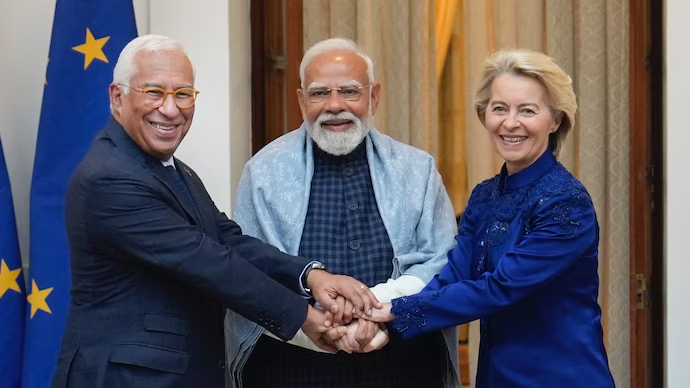
EU leaders made clear the agreement also carries political weight. Von der Leyen called it a “strong message that cooperation is the best answer to global challenges,” while European Council President António Costa said it signals a preference for trade agreements over tariffs.
Regulatory and Compliance Challenges
Experts warn that Indian manufacturers may face difficulties meeting EU’s stringent environmental and regulatory standards.
Economist Mitali Nikore said India’s manufacturing sector is not yet fully prepared for compliance with EU rules, especially on climate and carbon mechanisms, but added that the pact represents “an opportunity more than a challenge.”
EU Perspective: Strategic Certainty
For Europe, the agreement provides economic stability and strategic diversification at a time of global uncertainty. Germany and France are expected to be among the largest beneficiaries.
According to Andrew Small of the European Council on Foreign Relations, the deal is seen as a foundation rather than a final outcome, with scope for deeper integration in the future.
Security and Defence Cooperation
Parallel to the trade pact, India and the EU are advancing negotiations on a security and defence partnership, covering:
India’s Defence Minister Rajnath Singh confirmed discussions with EU officials on building future-ready defence capabilities.
Approval and Next Steps
The agreement will be formally signed later this year after approval by the European Parliament and EU member states. While other EU trade deals have faced political resistance, the India pact is considered less contentious due to balanced concessions on both sides.
Trade Reminder: EU–India Economic Ties
The EU–India free trade agreement is the largest trade pact ever signed by India and one of the most strategically significant for the EU. Beyond tariffs, it signals a deeper political, economic and security alignment between two major global powers navigating an increasingly fragmented world economy.